Redwood City, CA · Garage Door Service
When the Power Blinks and Your Opener Won't: A Redwood City Guide
How Redwood City's 1947-1988 housing stock and mild climate affect opener failures and power outages, what to check yourself, and what repair typically involves here.
- Repairs & new doors
- Springs & openers
- Serving 4 nearby communities
Checking It Yourself
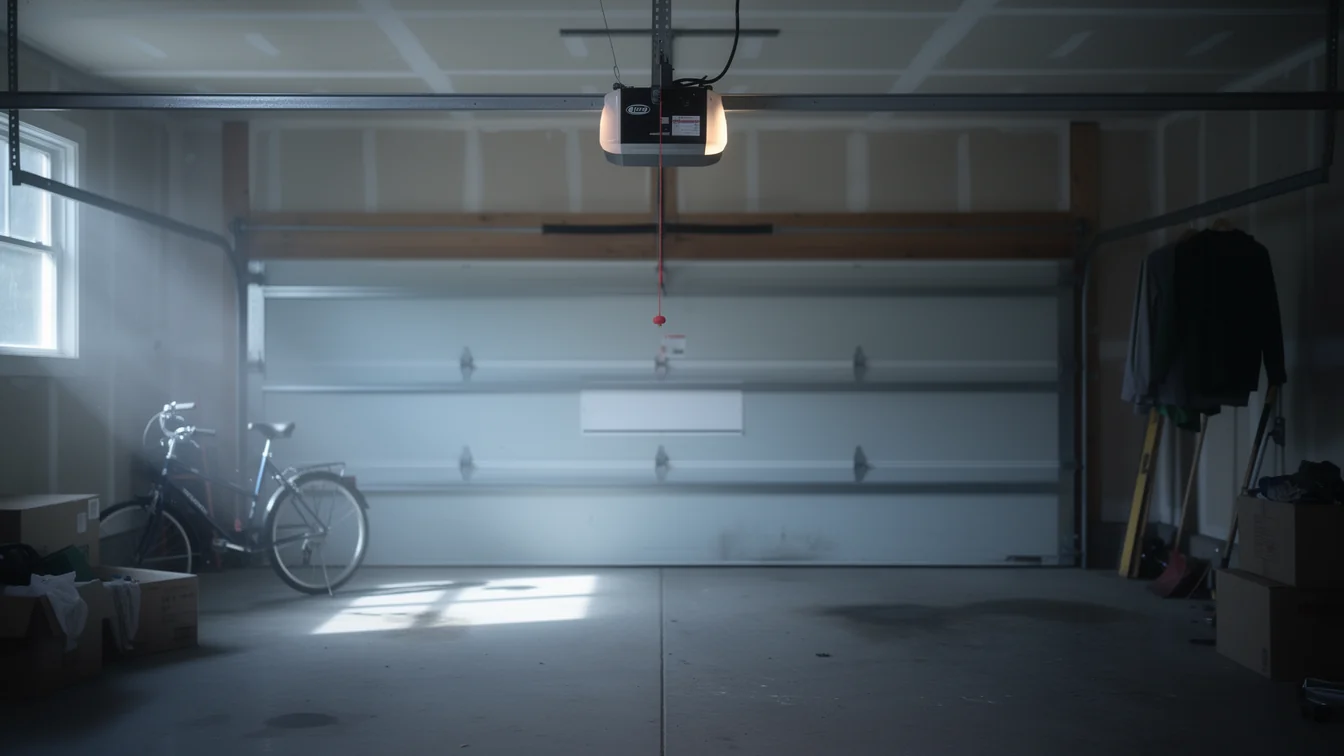
Before you call anyone, open the garage by hand. Pull the red release cord hanging from the trolley and lift the door yourself. If it's heavy or won't stay up on its own, the problem is a spring, not the opener, and that's not a DIY fix. If the door lifts easily and stays put, the opener itself is the suspect.
Next, check the wall outlet the opener plugs into. A lot of houses in this area were built between 1947 and 1988, with most of the stock dating to the 1960s and '70s, and garage outlets from that era are often on a single circuit shared with exterior lights or a side-yard receptacle. A tripped GFCI outlet looks dead but isn't broken - push reset before you assume the opener itself failed.
After a power outage, check whether the opener's safety sensors (the two small eyes near the floor on each side of the track) have shifted. Power loss and the jolt of restoration can knock an older bracket loose, especially on openers original to a 1960s or '70s build that have never been touched. If the light on one sensor blinks instead of staying solid, that's your answer - it won't close until they're aligned.
If none of that solves it, stop. Repeated testing can strip a logic board or burn out a capacitor that was already on its way out.
What It Costs
We don't have a flat number to hand you here, and we'd rather tell you that than make one up. What drives the cost on any given job is whether you're replacing a logic board, a capacitor, a full opener unit, or just resetting sensors and a circuit - and that depends on the age and model of what's already mounted on your ceiling.
What we can tell you locally: with most garages in the area dating to the 1960s and '70s, a lot of openers in these homes are not original - they've been swapped once already, sometimes twice - which means the unit in your garage may be newer than the house around it, or it may be the same age as the door tracks and genuinely due. That mismatch is common enough here that we don't assume anything about your opener's age from your home's build year alone.
One honest limitation: if your opener is an older chain-drive unit with a burned motor after a power surge, parts for some discontinued models take time to source, and a full replacement often makes more sense than a repair. We'll tell you straight if that's your situation rather than stringing out a repair that won't hold.
What Is Going On
Most opener failures after a power outage come down to one of three things: the logic board lost its memory of the travel limits, a surge during the outage fried a capacitor or the board itself, or the backup battery (if the unit has one) didn't hold and the unit powered down mid-cycle.
Houses here that still run original or early-generation openers - common given the 1960s-70s building wave across the area - are more likely to lack surge protection built into the unit, since that wasn't standard equipment decades ago. A power outage hits those openers harder than a newer unit with integrated surge suppression.
We also see openers that simply won't respond to the remote after a cut but work fine from the wall button. That's almost always the remote's rolling code falling out of sync with the receiver, not a hardware failure - a five-minute reprogram, not a repair.
How Local Conditions Play In
Redwood City sits in a mild temperate band, so we don't get the extreme cold-snaps or triple-digit heat that stress an opener's motor or warp a chain. That's good news - it means openers here fail less often from pure thermal strain than in harsher climates.
What we do see tied to the climate is condensation inside older logic board housings during the cooler, damper stretches of the year, especially in garages that sit below grade or close to the bay-facing side of town. That moisture can corrode a board's contacts slowly, long before any single power outage ever happens - so when the outage finally does knock it out, the board was already compromised.
The mild climate also means most openers here run longer than they would somewhere with harsher swings, which circles back to the age mismatch we mentioned earlier: a unit can be old enough to lack surge protection but still be running fine day to day, right up until a power event finds its weak point.
Frequently asked questions
My opener won't respond after the power came back on. Is it dead?
Not necessarily. Check if the wall button works even though the remote doesn't - that points to a rolling-code sync issue, which is a quick fix. If neither the wall button nor the remote does anything, the logic board or a capacitor likely took the hit.
Why does this keep happening every time the power blips?
If your opener is an older unit from the original 1960s-70s building wave in this area, it may lack built-in surge protection that's now standard. Each power event stresses the same weak point until it fails for good.
Can I just reset the opener myself after an outage?
Usually yes - most units have a learn or reset button near the antenna that re-establishes travel limits and remote codes. If the door moves but stops short or reverses unexpectedly after that, the limits need manual adjustment, which is where we'd step in.
Related garage door services in Redwood City
More garage door guides
Book garage door service in Redwood City
Call now or request a quote - tell us what the door is doing and where you are.