Redwood City, CA · Garage Door Service
Why a Garage Door Spring Fails on a Cold Redwood City Morning
Redwood City's mild climate rarely freezes a torsion spring, but houses from the 1947-1988 building boom still carry original hardware that's due to fail. Here's what to check and what it costs.
- Repairs & new doors
- Springs & openers
- Serving 4 nearby communities
Checking It Yourself
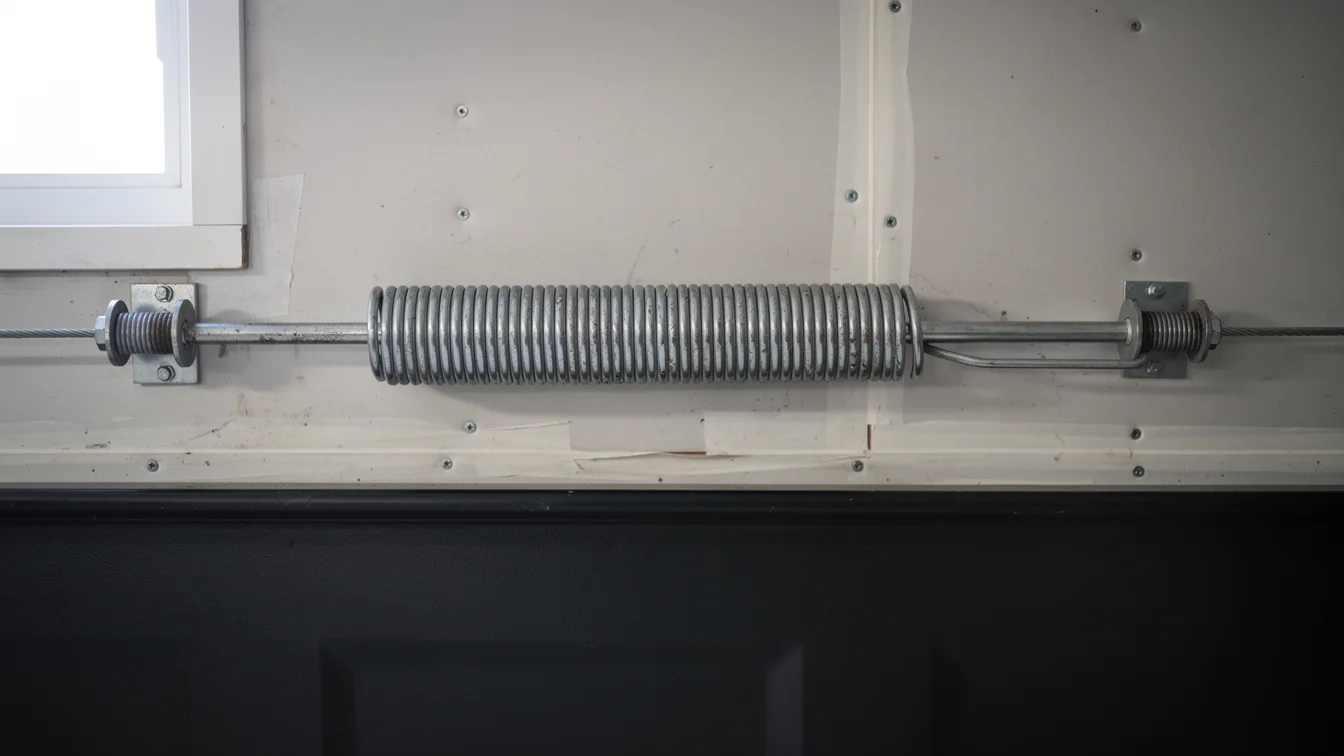
Before you call anyone, look at the spring itself. Most Redwood City garage doors still run on torsion springs mounted on a shaft above the door, and if one has gone, you'll see a visible gap in the coil - it looks like the spring snapped in half and the two ends have sprung apart. Don't try to close that gap by hand and don't release the winding cones; that tension is enough to break a finger.
A second check: pull the door down by hand with the opener disconnected (there's a red release cord). A door with a healthy spring should stay roughly level and lift with one hand. If it drops like dead weight or you need both arms to hold it, the spring has lost its tension even if it hasn't snapped yet.
Also look at the age of the hardware. If the house dates from Redwood City's main building era - the 1947-to-1988 run, with the typical home going up around 1966 - you're likely looking at original or first-replacement torsion springs. That's 50-plus years of winding and unwinding on the same shaft, and galvanized coating wears thin long before the steel actually snaps.
One thing I won't tell you to do yourself: wind or unwind the spring. That's the one repair where guessing wrong puts you in the ER, not just out a door.
What It Costs
I don't have a flat number to give you here, because the real cost swings on things I can't know without seeing the door - spring size, whether it's one spring or a matched pair, and whether the door is a standard single or the heavier double common on wider Redwood City lots. What I can tell you is what drives the price up or down: a single spring on a one-car door is a different job than replacing a matched pair on a double door that's been running unevenly for months and has worn out a roller or two in the process.
Redwood City's median household income sits around $168,832, which is relevant mainly in one way - most homeowners here aren't choosing between fixing the spring and replacing the whole door on cost alone. The decision usually comes down to the door's age and condition, not the household budget. If the door itself is original to a house built in the 1960s, a spring repair might be the smaller problem compared to worn tracks or a dead opener motor sitting on the same unit.
The honest limit: I'm not going to quote a number sight unseen, and anyone who does without looking at your spring size and door weight is guessing too.
What Is Going On
A torsion spring is just stored tension - it winds up tight and that tension does the lifting work the opener motor would otherwise have to do alone. Every time the door opens and closes, the spring flexes slightly. Do that for decades and the metal fatigues the same way a paperclip weakens after enough bends, even without any dramatic event to blame.
In Redwood City, that fatigue clock mostly started a long time ago. With the typical house dating to 1966 and the wider stock spread across 1947 to 1988, a lot of torsion springs on the Peninsula are either original or are the first replacement from decades back. Nobody flags a spring for service until it fails, so the failure point sneaks up - one morning the door won't lift, and the spring that's been slowly losing tension for two years finally lets go.
Steel also loses a little flexibility as it cools, which is why a borderline spring is more likely to actually snap on a cold morning than on a warm afternoon, even without a hard freeze. It's not the cold causing the failure - it's the cold finding a spring that was already near the end.
How Local Conditions Play In
Redwood City sits in a mild temperate band, the same one shared by nearby communities like San Carlos and Belmont a few miles off. That matters here because it means your spring isn't fighting the deep freeze-thaw cycles that crack steel in harsher climates - no ice expanding in a coil, no repeated hard freezes working the metal.
What the mild climate doesn't do is stop ordinary age. Across this part of the Peninsula, with roughly 166,417 owner-occupied houses and most of that stock built between the late 1940s and the late 1980s, a big share of garage doors are still running on hardware that predates most of the owners currently living there. Mild weather slows corrosion and keeps lubricant from gumming up as badly as it would somewhere with real winters, but it doesn't reset the fatigue clock on a 40-year-old torsion spring.
So the pattern here isn't a storm snapping springs overnight. It's a slow fade - tension bleeding off year by year until a cool morning, with the metal slightly less pliable than it was in July, is the one that finally breaks it.
Frequently asked questions
Why did my spring break on a cold morning if Redwood City doesn't get hard freezes?
Steel gets a little less flexible as it cools, even in a mild climate like ours. If a spring is already fatigued from decades of use - common in houses from Redwood City's 1947-to-1988 building era - a cool morning is often what finally finishes it off. The cold isn't the cause, it's the trigger on a spring that was already near its limit.
How do I know if my spring is original to the house?
If your house was built anywhere in that 1947-to-1988 run that makes up most of Redwood City's housing stock, and nobody's mentioned replacing the spring, assume it's either original or a decades-old first replacement. Visible rust, flattened coils, or a door that's gotten noticeably heavier to lift by hand are signs it's close to the end.
Is it safe to replace a torsion spring myself?
No. A torsion spring under tension can cause serious injury if the winding cones slip or the bar isn't seated right. This is one of the few garage door jobs where I'd tell you flatly to call someone rather than watch a video and try it yourself.
Related garage door services in Redwood City
More garage door guides
Book garage door service in Redwood City
Call now or request a quote - tell us what the door is doing and where you are.